Illustrated in Soviet propaganda poster art with dark twist style
The Butcher's Lessons
A Soviet Tale of Red Tape and Red Forests
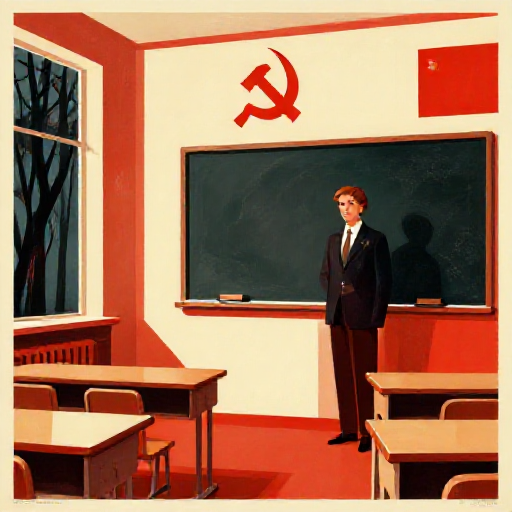
Andrei was a schoolteacher in the Soviet Union. He was not a very good teacher. The children laughed at him and the other teachers ignored him. Andrei could not command a classroom. But he discovered he could command something else entirely, out in the forests near the train stations.
Chikatilo was a frustrated teacher who was mocked by students and unable to maintain classroom discipline.
The forests around Rostov-on-Don were dark and deep. Andrei would meet people at the train stations and invite them for a walk. Runaways, homeless people, children who should have been in school. Fifty-two people walked into those forests with Andrei. None of them walked out.
Chikatilo murdered at least 52 people between 1978 and 1990, luring victims from train and bus stations.
The Soviet police had a problem. Serial killers were supposed to be a Western disease. 'We don't have serial killers in the Soviet Union,' they said. So they arrested an innocent man instead and executed him. Problem solved! Except the murders continued. The Soviet system was very good at many things. Admitting mistakes was not one of them.
Aleksandr Kravchenko was wrongfully convicted and executed for one of Chikatilo's murders. Soviet ideology denied serial killers could exist under communism.
Andrei was actually caught once, in 1984. His blood type didn't match the evidence. So they let him go. What they didn't know was that Andrei had a rare condition: his blood and saliva gave different blood type readings. Science failed, and Andrei went back to the forest for six more years.
Chikatilo was detained in 1984 but released because his blood type (A) didn't match the semen evidence (AB), due to a rare secretor status anomaly.
In the end, they caught Andrei the old-fashioned way: a policeman saw him coming out of the woods looking suspicious. Fifty-two people. Twelve years. And it came down to a cop who thought a man with a briefcase near a forest looked a bit odd. Andrei was executed in 1994. The forest is quieter now.
Chikatilo was finally caught in 1990 through a massive surveillance operation. He was convicted of 52 murders and executed by firing squad in 1994.